
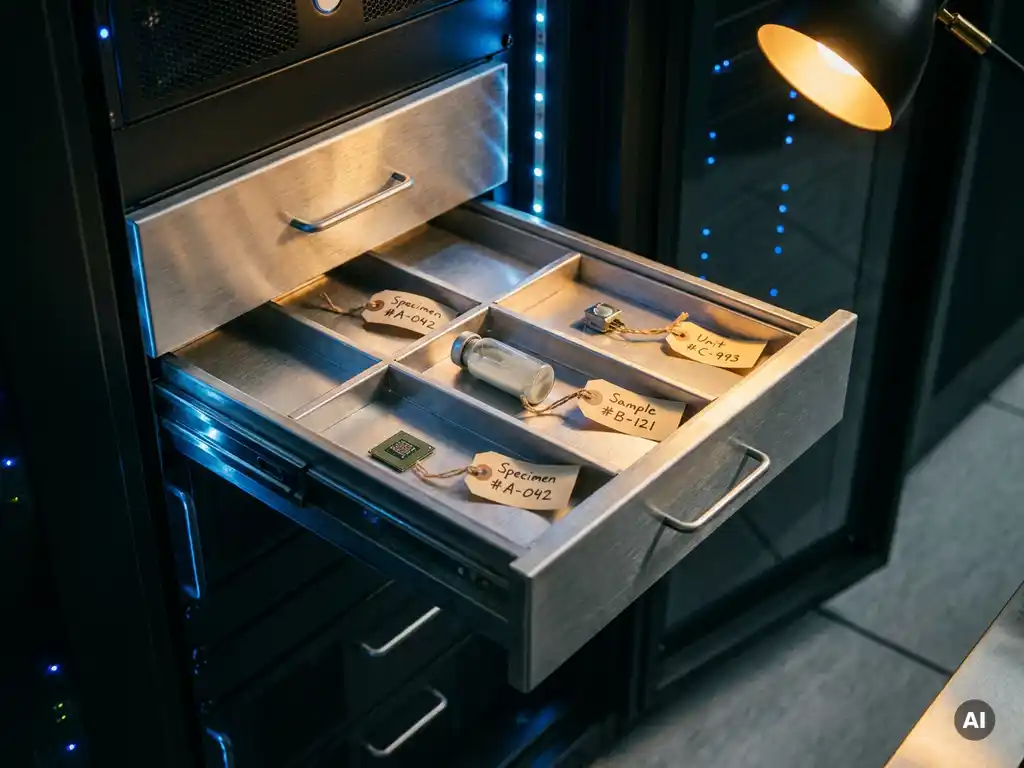
Metadata is what makes raw data usable for AI models. Without it, a dataset is just a collection of values with no context, no provenance, and no trust signal. For AI systems to train reliably, make accurate predictions, and pass compliance checks, every dataset needs descriptive, structural, and operational metadata that tells the model what the data means, where it came from, and whether it can be trusted.
This matters most in industries like manufacturing, energy, and agritech, where data arrives from sensors, SCADA systems, and MES platforms alongside traditional databases. In those environments, metadata is not a documentation exercise; it is the engineering foundation that separates AI-ready data from data that just sits in a lake. The sections below unpack the specific metadata questions that every data platform team should be able to answer.
How does metadata make data usable for AI models?
Metadata makes data usable for AI models by providing the context that transforms raw values into interpretable, trustworthy inputs. Without metadata, a model cannot distinguish a temperature reading in Celsius from one in Fahrenheit, cannot know whether a null value means zero or missing data, and cannot verify that the training data reflects the same business logic as the inference data.
Practically, metadata enables three things that AI pipelines depend on. First, it provides semantic meaning: field names, units, and business definitions that tell a model what a column actually represents. Second, it provides quality signals: freshness timestamps, completeness scores, and validation rules that tell a model whether a dataset is fit for purpose. Third, it provides provenance: the origin and transformation history of data that allows teams to audit predictions and trace errors back to their source.
When metadata is absent or inconsistent, AI teams spend the majority of their time on manual data archaeology rather than model development. The 80/20 problem, where 80% of effort goes into cleaning and moving data, and only 20% into delivering value, is almost always a metadata problem at its root.
What are the different types of metadata in a data platform?
A data platform typically manages four distinct types of metadata, each serving a different function in making data AI-ready. Understanding the difference helps teams decide where to invest in tooling and governance.
- Technical metadata describes the physical structure of data: schemas, data types, column names, file formats, and table sizes. This is the baseline that data engineers rely on to build and maintain pipelines.
- Business metadata provides semantic context: what a field means in business terms, which team owns it, and what rules govern its acceptable values. This is what bridges the gap between a raw column name like trx_amt_usd and a meaningful concept like “net transaction value in US dollars.”
- Operational metadata tracks the runtime behavior of data: when a pipeline last ran, how long it took, how many records were processed, and whether any quality checks failed. This is essential for observability and alerting.
- Lineage metadata records how data moves and transforms across the platform, from source to staging to mart to model input. This deserves its own section because of how critical it is to AI specifically.
Most modern data platforms capture technical metadata automatically. Business metadata requires deliberate effort and ownership. Operational and lineage metadata depend on how well the pipeline engineering is instrumented from the start.
What is data lineage and why does it matter for AI?
Data lineage is a record of where data originated, how it was transformed, and where it has been used across a data platform. For AI specifically, lineage matters because it is the only way to answer the question every model audit eventually asks: “Where did this training data come from, and can we trust it?”
Without lineage, debugging a model that produces unexpected outputs is extremely difficult. A prediction that looks wrong could be caused by a broken upstream join, a schema change in a source system, a filter that silently dropped records, or a business rule that was applied inconsistently. Lineage metadata makes each of those failure modes visible and traceable.
Lineage also matters for reproducibility. Regulatory frameworks and internal audit requirements increasingly demand that AI teams demonstrate they can recreate the exact dataset used to train a deployed model. Column-level lineage, not just table-level, is the standard that serious AI platforms are moving toward, because it shows not just which tables were used but which specific transformations were applied to which fields.
In OT-heavy environments like manufacturing and energy, lineage takes on additional complexity. Data flowing from a historian database or SCADA system through a normalization layer into a feature store may pass through five or six transformation steps. Each one needs to be tracked, or the lineage record becomes incomplete and therefore unreliable.
How does a data catalog improve AI pipeline reliability?
A data catalog improves AI pipeline reliability by giving every team member (data engineers, ML engineers, and business analysts) a single, searchable source of truth about what data exists, what it means, and whether it is trustworthy. Without a catalog, teams rely on tribal knowledge, which breaks down as organizations scale.
For AI pipelines specifically, a well-maintained catalog reduces the risk of using the wrong dataset as a model input. When a feature engineer can look up a dataset and immediately see its owner, its update frequency, its known quality issues, and its lineage, they make better decisions about which data to include in a training set. That directly reduces the rate of model failures caused by data issues rather than modeling errors.
A catalog also accelerates onboarding and reduces duplication. When new team members can discover existing datasets rather than rebuilding them from scratch, the platform becomes more efficient. And when quality metrics are surfaced in the catalog alongside the data itself, reliability becomes visible rather than assumed.
What metadata standards should a data platform support?
A data platform built for AI workloads should support open metadata standards that enable interoperability, tooling integration, and long-term maintainability. Relying on proprietary metadata formats creates lock-in and limits the ability to swap out components as the modern data stack evolves.
The most important standards to consider include:
- OpenLineage: an open standard for lineage metadata that integrates with orchestration tools like Apache Airflow and dbt, making lineage collection automatic rather than manual.
- OpenMetadata or DataHub schemas: open frameworks for cataloging assets, ownership, and quality metadata across a heterogeneous platform.
- dbt documentation and testing conventions: if dbt is part of the transformation layer, its built-in metadata generation (schema.yml, test results, docs) is a practical and widely adopted standard for business and quality metadata.
- DCAT (Data Catalog Vocabulary): a W3C standard relevant for organizations that need to publish or federate metadata across organizational boundaries, increasingly relevant under EU data governance regulations.
The practical test for any metadata standard is whether it can be enforced in code rather than in documents. Standards that live in a wiki page are aspirational. Standards that are validated in a CI/CD pipeline are operational.
When does poor metadata become an AI compliance risk?
Poor metadata becomes a compliance risk the moment an AI model influences a decision that must be explainable, auditable, or subject to regulatory oversight. In 2026, this threshold is lower than most organizations expect, driven by the EU AI Act and NIS2 requirements that apply directly to sectors like energy, manufacturing, and healthcare.
The EU AI Act requires that high-risk AI systems maintain documentation of training data, including its provenance, quality assessment, and known limitations. If your metadata infrastructure cannot produce that documentation automatically, compliance becomes a manual, expensive, and error-prone process. Gaps in lineage metadata are particularly dangerous because they make it impossible to demonstrate that training data was appropriate and unbiased.
NIS2 adds a different dimension: it requires organizations to demonstrate control over their data infrastructure, including the ability to detect and respond to integrity failures. A pipeline that silently corrupts data without triggering an alert, because operational metadata and monitoring are absent, is a NIS2 exposure as much as a data quality problem.
The compliance risk is not theoretical. Regulators are beginning to ask for model cards, data sheets, and audit trails that trace predictions back to source data. Organizations without mature metadata infrastructure will find that compliance work becomes a crisis rather than a routine process.
How Itility helps build metadata-driven, AI-ready data platforms
Most data teams know what good metadata looks like in theory. The challenge is building it into the platform from the start, rather than retrofitting it after pipelines are already in production. That is where we work alongside data engineering teams to make metadata operational, not aspirational. Our approach to data and software engineering is built around exactly this principle.
We design and build data platforms where metadata is engineered in, not documented after the fact. That means:
- Lineage tracking built into every pipeline using OpenLineage-compatible tooling, so traceability is automatic from day one
- Data quality checks and observability instrumented at the pipeline level, with alerting that catches failures before they reach a model or a report
- Data catalog integration that surfaces ownership, freshness, and quality metadata to every team that consumes data
- OT-IT integration that normalizes sensor data, SCADA, and MES outputs into the platform with full lineage from the factory floor to the feature store
- Governance structures enforced in code, not in a document, so standards hold as the platform scales
If your team is dealing with pipelines that break silently, training data that cannot be audited, or compliance requirements that your current metadata infrastructure cannot support, talk to us about what a production-ready, AI-ready data platform looks like in practice.
Frequently Asked Questions
How do we get started with metadata management if our pipelines are already in production?
Start with an audit of what metadata already exists implicitly in your stack — schema registries, pipeline logs, and any dbt documentation are common starting points. From there, prioritize instrumenting lineage and operational metadata first, since those deliver the most immediate value for debugging and observability. Retrofitting metadata is harder than building it in from the start, but a phased approach that targets your highest-risk or most business-critical pipelines first will produce measurable results quickly without requiring a full platform rewrite.
What is the difference between data quality monitoring and operational metadata, and do we need both?
Operational metadata tells you what happened during pipeline execution — run times, record counts, and job status — while data quality monitoring tells you whether the data that came out of that pipeline meets defined standards, such as completeness thresholds or value range checks. They are complementary, not interchangeable: operational metadata catches infrastructure and process failures, while quality metadata catches semantic and content failures. For AI pipelines specifically, you need both, because a pipeline can complete successfully and still produce a dataset that is unfit for model training.
How granular does lineage need to be — is table-level lineage enough for most AI use cases?
Table-level lineage is a useful starting point, but it is rarely sufficient for serious AI workloads. When a model produces unexpected outputs, table-level lineage tells you which datasets were involved but not which specific transformations, filters, or joins introduced the issue. Column-level lineage is increasingly the standard for AI platforms because it allows you to trace exactly how each feature in a training set was derived, which is also what regulators under the EU AI Act are beginning to expect when they ask for training data documentation.
What are the most common metadata mistakes teams make when building their first AI-ready data platform?
The most common mistake is treating metadata as a documentation task rather than an engineering task — writing descriptions in a wiki that quickly become outdated instead of enforcing standards in code through CI/CD pipelines and automated tests. A close second is capturing only technical metadata (schemas and data types) while neglecting business metadata and lineage, which leaves models with no semantic context and no audit trail. Teams also frequently underestimate the complexity of OT data sources: sensor and SCADA data requires additional metadata layers for units, sampling frequency, and calibration history that standard data catalog tooling does not handle out of the box.
Can we use our existing data catalog tool, or do we need to replace it to become AI-ready?
In most cases, the issue is not the catalog tool itself but whether it is being actively maintained and integrated into the pipelines that feed AI models. Tools like DataHub, OpenMetadata, or Atlan can all support AI-ready metadata management if they are configured to surface quality scores, lineage, and freshness data alongside the assets themselves. The more important question is whether your catalog is connected to your actual pipelines via standards like OpenLineage, or whether metadata is being entered manually — because manual entry does not scale and degrades quickly as the platform evolves.
How does metadata management change when we are dealing with real-time or streaming data from sensors and OT systems?
Streaming and OT data introduce metadata challenges that batch pipelines do not face: values arrive continuously, units and calibration parameters can change without a schema migration, and late-arriving or out-of-order data can silently corrupt time-series features. This means operational metadata needs to include stream lag, event-time versus processing-time distinctions, and sensor health indicators, not just job completion status. Lineage also becomes more complex because a single feature used in a model may aggregate data from dozens of sensors across multiple normalization and resampling steps, each of which needs to be tracked to maintain a complete audit trail.
What should we look for when evaluating whether our metadata infrastructure is ready for EU AI Act compliance?
The key test is whether your platform can automatically produce documentation of training data provenance, quality assessments, and known limitations for any deployed model — without relying on manual reconstruction after the fact. If answering the question ‘what data was this model trained on, and how was it processed?’ requires interviewing engineers or digging through unstructured logs, your metadata infrastructure has a compliance gap. Specifically, look for column-level lineage coverage on your feature pipelines, documented data quality checks that ran at training time, and a catalog that records dataset ownership and update history in a format that can be exported for a regulatory audit.